
What Propeller Works Best for Bass Fishing Boats?
In short: The best prop can transform your boat’s hole shot, improve top speed, fuel efficiency, stability, and even save you money at the pump. But with so many options out there, how do you know which one is the best choice? Are stainless steel props worth the extra cost over aluminum? How does prop pitch affect your RPM and top-end speed?
If you’re wondering how to find the perfect match for your bass boat, you’ve come to the right place. This guide will break down everything you need to know to select the best prop for your fishing needs. Read on!
Why Does the Right Prop Matter for Your Bass Boat?
You can have the most powerful engine for your car, but with the wrong tires, you won’t get the traction for the road. The same goes for your boat.
A mismatched propeller can lead to tons of problems:
- Poor Hole Shot: A slow start getting on plane means you spend more time getting to your fishing spot.
- Low Top Speed: You might not be reaching your boat’s full speed potential.
- Engine Strain: Running the wrong prop can cause your engine to operate outside its recommended max RPM range, leading to premature wear.
- Bad Fuel Economy: An inefficient prop makes your motor work harder, burning more fuel for the same distance.
Choosing the right propeller is a matter of balancing your boat’s weight, hull design, and engine power with your performance goals.

Stainless Steel Prop vs. Aluminum Props
When selecting a new prop, the first decision is usually material. The two main contenders are aluminum and stainless steel.
Aluminum Props
They are lightweight and significantly cheaper than their stainless steel counterparts. For a casual boater with a lower-horsepower engine, an aluminum prop is often a perfectly fine choice.
However, if you frequent shallow waters or areas with submerged debris, you can expect to see dents and dings. Even a minor impact can bend a blade. This throws the prop out of balance and hurts performance. Propellers are a great spare, but for serious bass fishing they have limitations.
Stainless Steel Prop
For a bass boat, a stainless steel prop is almost always the superior option. Here’s why:
- Durability: Stainless steel is up to five times stronger than aluminum. It can withstand impacts that would destroy an aluminum prop.
- Performance: These blades have lower drag and flex, resulting in better performance. You can expect a better hole shot, improved top-end speed (often 2-3 MPH faster than an aluminum prop of the same pitch), and more lift.
- Efficiency: The enhanced blade design and reduced flex improve fuel economy, helping you save money over the long run.
While a stainless steel prop costs more upfront, the performance gains and longevity make it a worthwhile investment for any serious bass fishing.
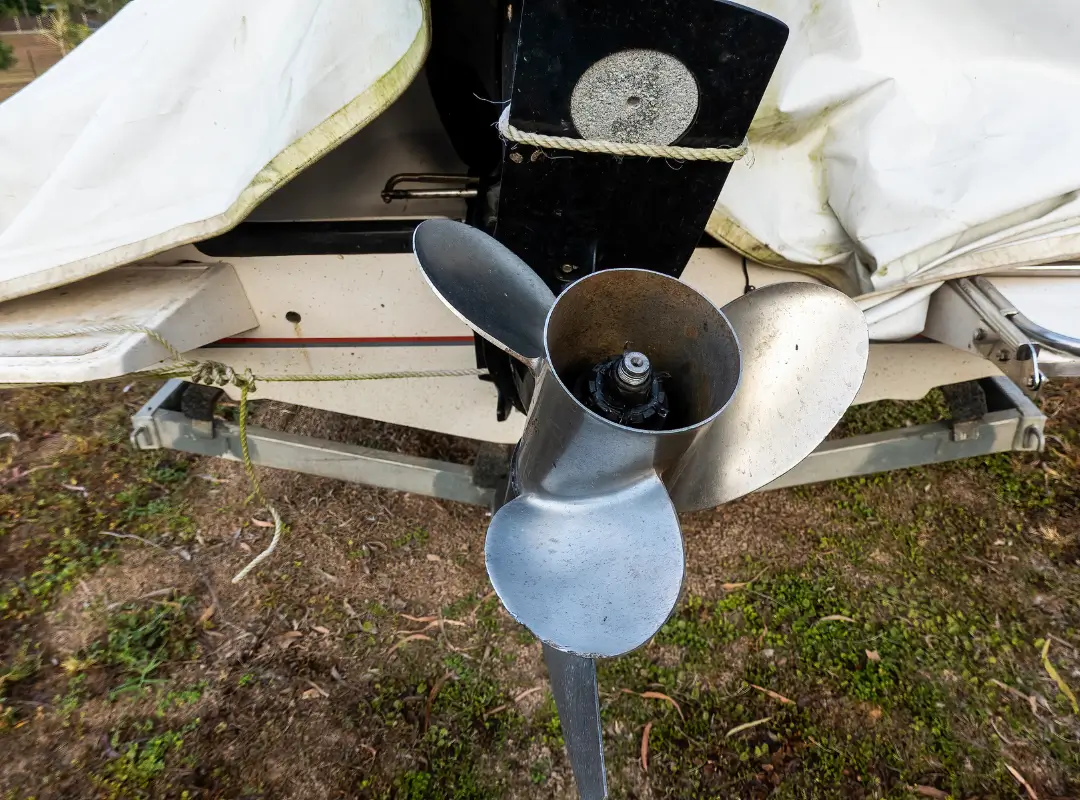
Prop Pitch & Its Impact on Top Speed
What is a prop pitch in the first place? It is the theoretical distance, in inches, that a propeller would move forward in one rotation if it were moving through a solid medium. Think of it like a screw turning into a piece of wood. Here’s how it works and which one to choose from, higher or lower pitch?:
Lower Pitch
A lower pitch prop allows your engine to rev up more quickly. This results in an excellent hole shot and is great for carrying a heavy load. However, it will limit your top speed, much like driving a car in a lower gear.
Higher Pitch
A higher-pitch prop provides a higher top-end speed because the boat moves farther with each rotation. The trade-off is a slower hole shot. It’s like starting your car in a higher gear; it takes longer to get going.
Generally, a one-inch increase in pitch will decrease your WOT RPM by about 150-200. The goal? Choose a prop pitch that allows your engine to operate within its manufacturer-recommended max RPM range at WOT with your typical load.
3 Blades vs. 4 Blades
Another key consideration is the number of blades. For bass boats, the debate is almost always between 3-blade and 4-blade propellers.
3-Blade Propellers
Because they have less drag than 4-blade props, they typically deliver the highest top-end speed. If your main goal is hitting the maximum MPH your rig can achieve, a 3-blade prop is often your best bet. Popular models like the Mercury Fury and Tempest Plus are prime examples of high-performance 3-blade props.
4-Blade Propellers
A 4-blade prop has more blade surface area in the water. This provides several advantages:
- Superior Hole Shot: That extra blade gets a better grip on the water, launching your boat on plane much faster. This is a huge advantage in tournaments.
- Better Handling: 4-blade props provide greater stern lift, helping stabilize the boat, especially in rough water. They tend to hold the water better during sharp turns.
- Cruising Efficiency: They often allow you to stay on plane at lower speeds, which can improve fuel economy during cruising.
The trade-off? You might lose 1-2 MPH of top-end speed compared to a 3-blade prop of the same pitch. For many anglers, the improved hole shot and handling are well worth this small drop in speed.
Frequently Asked Questions
What Is The Fastest Prop For A Bass Boat?
Generally, a 3-blade stainless prop with the highest pitch that still allows your engine to reach its optimal WOT RPM range will be the fastest. Models known for top speed, like the Mercury Fury, are popular choices. However, hull design and boat load play a significant role in achieving maximum speed.
What's Faster, A 3 Blade Or A 4 Blade Prop?
A 3-blade prop is typically faster. With less blade surface area in the water, less drag is created, allowing for a higher top-end speed. A 4-blade prop trades a small amount of that top speed (usually 1-2 MPH) for a significantly better hole shot, improved handling, and better performance in rough water.
What Is The Best Type Of Propeller For A Boat?
For a bass boat, a stainless steel propeller is almost always the best choice due to its durability and performance advantages. It provides a better hole shot, higher top speed, and improved fuel economy compared to an aluminum prop. The specific design (3-blade vs. 4-blade) depends on your performance priorities.
Is A 19 Or 21 Pitch Prop Faster?
A 21-pitch prop is faster, assuming the engine can reach its proper RPM range with it. A higher-pitch propeller moves the boat farther with each rotation, resulting in a higher top speed. However, if the 21-pitch prop lugs the engine down and prevents it from reaching its WOT RPM, a 19-pitch prop might actually be faster on that specific boat setup.
Conclusion
A well-matched prop improves your hole shot, stabilizes handling in tricky waters, and can even save fuel over time. Remember, it’s not just about hitting maximum MPH; it’s about finding a prop that complements your engine, hull, and typical load. With the right combination, your bass boat will feel responsive, efficient, and ready to handle anything the water throws at you.
Ready to Upgrade? Check Out Prop Depot’s Selection!
If you’re serious about bass fishing, don’t settle for “good enough.” At Prop Depot in Tennessee, we carry a full range of new propellers and repair options to help your boat reach its full potential. From high-performance Mercury and ACME stainless steel props to budget-friendly aluminium options, we have everything you need to match your engine, hull, and fishing style.
Not sure which prop is right for you? We can guide you through everything to find the perfect fit. We also handle prop repairs and maintenance, ensuring your current prop continues performing at its best. Stop by our Tennessee location or call us today to explore our selection and get expert advice on the propeller that will take your bass boat to the next level.